Pump Or Barrow On A Civil Site?
Concrete pumping moves the mix from the agitator truck straight into the form, so your crew places and finishes instead of carting. On bridge decks, retaining walls, culverts and road barriers, that usually means fewer hands on barrows, a pour that keeps moving, and less risk of a cold joint.
The Short Version
- Pumping takes the barrow run out, so your labour goes into placing and finishing.
- The bigger prize is a pour that doesn’t stop. Fewer stoppages, fewer cold joints.
- A boom buys reach over an obstacle. A line pump buys access where a boom can’t set up.
- Set-up is where a civil pour loses its morning. Sort access, ground and washout first.
- We hire out the pump with an operator. Every site differs, so ring us for a quote.
What Pumping Actually Takes Out Of Your Day
It takes out the carting. Instead of a chain of barrows between the agitator truck and the form, the mix travels down the line and lands where the hose is pointed. Your people stop being couriers. They spread, screed, vibrate and finish while the pour keeps moving.
Fewer Hands On The Barrow
Barrowing is a headcount problem. The longer the run from truck to form, the more bodies you need just to keep the mix arriving, and none of that shows up in the finish. Put a pump on it and the same crew covers a bigger pour. A crew that has spent the morning pushing barrows across mesh isn’t the crew you want screeding the last bay.
A Pour That Keeps Moving
A barrowed pour moves at the speed of the slowest run. When the pace drops and one lift starts to go off before the next lands on it, you’ve got a cold joint, and on a bridge deck or a retaining wall that isn’t cosmetic. A pump keeps the mix arriving at the rate your crew sets, so the pour stays continuous.
Less Traffic Over Work You’ve Already Done
Every barrow run puts a wheel somewhere you’d rather it wasn’t. Planks over trench mesh, ruts through prepared subgrade, chairs knocked out of a reo cage. Pumping keeps that traffic off it.
So When Is Barrowing Still Fine?
Small volume, short run, flat ground, truck can back up close. If you can tip almost straight into the form and it’s done in one go, a pump is overkill and we’ll say so. The moment access gets awkward or the volume needs a second truck, the maths changes.
Boom Pump Or Line Pump On A Civil Job?
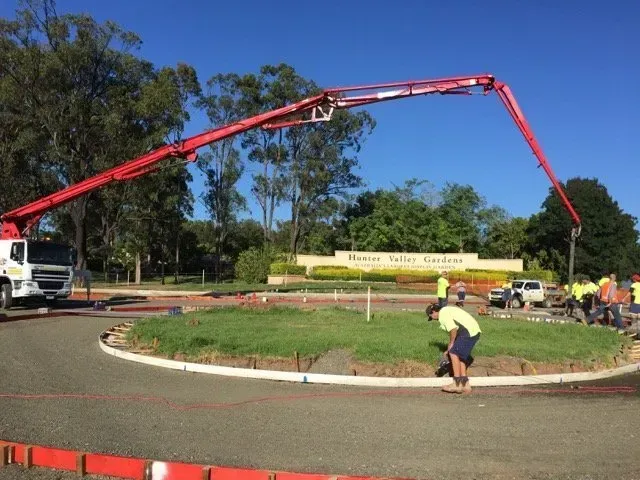
It comes down to reach against access. A boom pump places concrete over the top of an obstacle from one set-up. A line pump pushes it through hose along the ground, into places a boom can’t get to. Most sites answer the question themselves once you look at where the truck can stand and what sits in between.
Where A Boom Pump Earns Its Keep
Anything you have to go over rather than through. Bridge forms, deep excavations, barriers, batters, a live lane you can’t cross, a reo cage nobody should be walking on. One set-up covers a wide area, and the operator places the mix straight into the form.
The trade-off is what a boom needs from you: firm, level ground for the outriggers, room to swing, clear airspace above. Overhead powerlines can rule a position out completely, so flag them when you book, not on the morning.
Where A Line Pump Is The Better Call
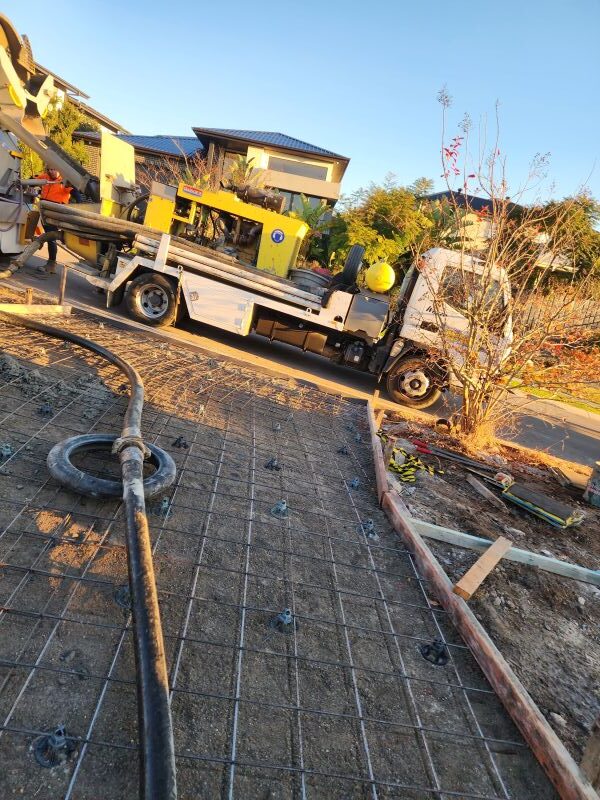
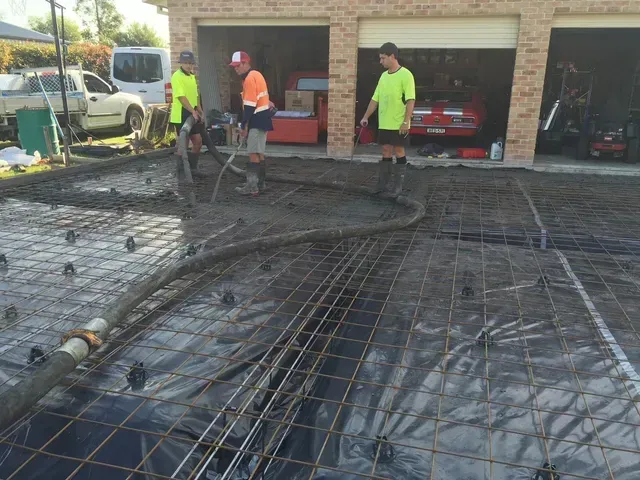
Low headroom and long, narrow runs. Drainage channels, culverts, footings and kerb work, pours under a deck or inside a structure, anywhere a boom has nowhere to sit. Hose takes longer to lay out than a boom takes to unfold, but it goes where the boom can’t. That’s the whole point.
And If Access Is Genuinely Tight
Rail corridors, trenches between existing structures and works inside a live facility often rule out anything full-sized. That’s what small and tight-access pumps are for. Tell us the width of the gap and we’ll tell you what fits.
Set-Up Is Where Civil Pours Lose The Morning
Pumping itself is rarely the slow part. What costs you is a set-up position that doesn’t work: soft ground under an outrigger, a washout point nobody agreed, traffic control not yet in place, a hose route re-planned while trucks sit there ticking over.
Worth walking through before the day:
- Ground under the set-up. Outriggers need firm, level bearing. Backfilled trenches, service pits and soft batters matter.
- Overhead services. Powerlines decide whether a boom can work a position at all.
- The exclusion zone. Nobody under the boom while it’s placing, which on a live site means working it into your traffic management.
- Truck standing and turning. Where does the agitator sit, and can the next one get in behind it?
- Washout. Agree the spot in advance. Concrete goes nowhere near a drain, a creek or a table drain on our watch.
What To Have Ready Before The First Truck Arrives
A lot of the delay on a civil pour is avoidable, and sorted the day before.
- Access route and set-up position agreed with someone who is actually on site.
- Formwork, reo and inspections signed off, not “should be right by then”.
- Your volume worked out. Our guide to estimating concrete volumes walks through it.
- Mix, slump and delivery spacing sorted with your batching plant.
- Water on site for priming and washout.
- Traffic control and the exclusion zone ready at start time, not being organised at start time.
- Site induction and paperwork sent through beforehand, not while trucks queue.
- Enough crew on the hose and the finish for the pour ordered.
The Civil Work We Pump Most
We pump civil and infrastructure work across Newcastle and the Hunter Valley, from Maitland through to Tea Gardens. Typical jobs:
- Bridge abutments and decks
- Retaining walls and cuttings
- Slipform road barriers
- Culverts and drainage channels
- Traffic islands, footpaths and ramps
- Slabs for substations and water assets
Working With Our Crew
Every pump we hire out comes with an operator, so you’re not finding someone to run it. Your crew handles the placing and the finish. We handle the pump, the line and the washout. If you need a hoseman or a spotter on the day, ask when you book.
Civil pours often want an early start, before the heat and the traffic. We plan those in with you in advance rather than treating them as a callout, so the pump is primed when your first truck arrives.
On price there’s no single answer worth publishing, because it turns on the pump, the volume, the access and the time on site. Give us the job and we’ll quote it. Call 0419 252 930 or send us the details.
Frequently Asked Questions
Which civil jobs benefit most from pumping?
The test is what sits between the truck and the form. Height, depth, a barrier or a live lane, and pumping wins easily. If the truck can almost tip straight into the form, it might not be worth it. Describe the access when you ring.
Does the pump come with an operator?
Yes. Running the pump is our job, not yours, so it’s one less role to roster. What you still need is enough of your own people on the hose and on the finish. Tell us the pour size when you book.
Boom or line pump, how do I choose?
Need to get over something? That’s a boom. Need to get through or under something? That’s a line pump. Send us the site layout, where the truck can stand and what sits in between, and we’ll tell you which suits.
How early can you start?
Early starts are normal on civil work and we plan them in when you book. We’re not an emergency callout service, so the earlier you lock in the date and start time, the easier it is to have the pump primed before your first truck.
What will it cost?
We quote each job rather than publish a figure, because no two civil pours work out the same. Ring us with the volume, the site address and how you want the pour staged, and we’ll work it through on the phone.
Do you travel outside Newcastle and the Hunter?
We cover Newcastle, Maitland, the Hunter Valley and Port Stephens as standard, and we’ll look at work further out with enough notice. Travel is discussed upfront when we quote, so there are no surprises later.
The Bottom Line
Civil sites don’t lose money on the pumping. They lose it on stopped pours, oversized crews, and set-ups sorted on the morning instead of the week before. Pumping fixes the first two. A walk-through fixes the third. Work out which pump suits the job, agree the access and washout early, and the pour becomes the easy part of the day.
Our Services
Get A Free Quote
Contact us today for a free, no-obligation quote on your concrete pumping needs.