

To work out how much concrete you need, multiply length × width × depth in metres. That gives you the volume in cubic metres (m³), which is exactly how concrete is ordered and how pumping is planned. For a slab 5m long, 4m wide and 0.1m deep, that’s 5 × 4 × 0.1 = 2m³. Get this number right and the rest of your pour day runs smoothly.
We hire out concrete pumps across the Hunter Valley, Newcastle, Maitland and Lake Macquarie, so we see what happens when the volume is off. Order short and the pour stops while you wait on a second truck. Order long and you’re paying for concrete that goes to waste. This guide shows you how to size a pour properly, then match it to the right pump.
How do I work out how much concrete I need?
Use one formula: length × width × depth = volume in cubic metres (m³). Measure every dimension in metres, multiply them together, and the answer is the amount of concrete you order. It’s the same maths the supplier and the pump operator both work from, so getting it right keeps everyone on the same page.
The trick is keeping your units consistent. Slab depth is usually given in millimetres, so convert it to metres first: 100mm becomes 0.1m, 125mm becomes 0.125m, 150mm becomes 0.15m. Mix metres and millimetres and your number will be wildly out. Once everything’s in metres, the multiplication is simple.
A quick worked example. Say you’re pouring a shed slab 6m × 5m at 100mm thick. That’s 6 × 5 × 0.1 = 3m³. If you thicken it to 150mm, it becomes 6 × 5 × 0.15 = 4.5m³. Same footprint, half again as much concrete. Depth makes a big difference, so measure it carefully.
How do you calculate concrete for a slab or driveway?
A slab or driveway is the easiest shape: it’s a flat rectangle, so length × width × depth does the job. Measure the full footprint in metres, convert your thickness to metres, and multiply. The result is your order quantity in m³, before you add anything for waste or uneven ground.
Rectangular slabs
For a standard rectangle, plug the numbers straight in. A 4m × 3m slab at 100mm is 4 × 3 × 0.1 = 1.2m³. A driveway 10m long and 3m wide at 125mm is 10 × 3 × 0.125 = 3.75m³. Round your final order up, never down, so you’re not caught short mid-pour.
L-shapes and odd footprints
Most real jobs aren’t a clean rectangle. The fix is simple: split the area into rectangles, work out each one separately, then add them together. An L-shaped slab becomes two rectangles. A driveway that widens at the gate becomes a long strip plus a square. Break it down, calculate each part, total it up.
How much concrete do you need for footings and columns?
Footings and columns use the same volume thinking, just with different shapes. A footing trench is a long rectangle: length × width × depth in metres. A round column is the area of the circle (π × radius²) multiplied by its height. Add every footing and column on the job to your slab figure for one combined order.
For strip footings, measure the trench. A footing 12m long, 0.4m wide and 0.3m deep is 12 × 0.4 × 0.3 = 1.44m³. If you’ve got several trenches, work each one out and add them together. Pad footings under posts are small rectangles, so the same method applies.
For round columns or piers, use π × radius² × height. A column 0.3m across has a radius of 0.15m, so a 3m-high pour is 3.14 × 0.15² × 3 = roughly 0.21m³ each. Multiply by the number of columns. These small volumes add up fast on a job with lots of piers.
Why add a bit extra to your concrete order?
Always order slightly more than the exact maths says, usually around 5-10% on top. Spillage, uneven sub-base, slab edges that aren’t perfectly square and a bit of over-dig in trenches all eat into your number. Running short mid-pour is far more costly than a small amount left over.
Here’s the practical reason it matters on pump day. Concrete sets on a clock. If the volume is short and you’re waiting on a top-up truck, the concrete already placed keeps curing while the new load is still on the road. That can leave a cold joint where the two pours meet, which is a weak point you don’t want in a slab.
We’ve seen plenty of pours stall over a missing half-metre of concrete. A small buffer in your order avoids the scramble. Talk to your concrete supplier about their batch sizes too, since ordering in their standard increments is usually cheaper and faster than an odd top-up.
Rule of thumb – calculate the exact m³, then add a small buffer for waste. It’s cheaper than a second truck.
How does your concrete volume decide which pump you need?
Your m³ figure, plus how far the concrete has to travel, decides the pump. Small residential pours with tight access usually suit a mini or line pump. Bigger slabs, high walls or pours over obstacles often need a boom pump for reach. Knowing your volume and your site access lets us match the right machine the first time.
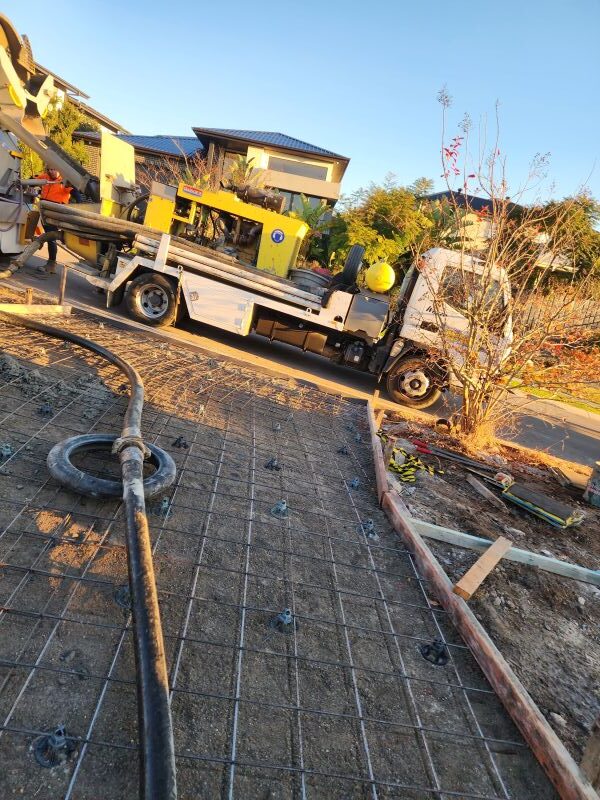
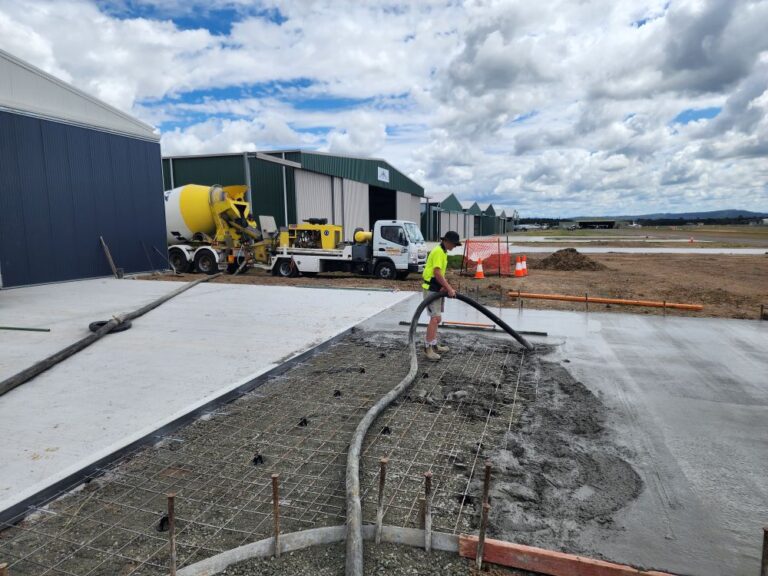
A line pump pushes concrete through a hose along the ground or up over a fence, which is ideal for slabs, driveways and tight backyards where a truck can’t get close. A boom pump uses a folding arm to place concrete up high or over a house, so it suits second-storey pours, large slabs and sites with no clear ground run.
The honest answer is that volume alone doesn’t decide it. A small pour behind a house can still need a pump because the truck simply can’t reach. Tell us the m³, the thickness, where the pour is and what’s in the way, and we’ll tell you which pump fits. That’s a quick phone call, not a site visit.
What does pump hire cost once you know your volume?
Pump hire pricing depends on a few things, not just your m³. The main drivers are pump type (mini, line or boom), how long the pour takes, site access and travel to your location across the Hunter. A small, easy-access residential pour costs less to pump than a large or awkward commercial job, so the fairest answer is a quote against your actual details.
We don’t publish a flat rate because no two pours are the same. A tight-access driveway in Maitland and a two-storey pour in Newcastle need different machines and different setups. Once you know your volume and your access, a quote takes minutes.
Give us the basics, your m³, slab thickness, suburb and a rough idea of access, and we’ll work out the right pump and a price. We run on planned bookings, so the more notice you give us, the easier it is to lock in your pour day. We’re based in Rutherford and cover the wider Hunter, Newcastle, Maitland and Lake Macquarie.
Frequently asked questions
How do I convert slab thickness from millimetres to metres?
Divide the millimetre figure by 1,000. So 100mm is 0.1m, 125mm is 0.125m, and 150mm is 0.15m. This step matters because the volume formula, length × width × depth, only works when every measurement is in the same unit. Slab thickness is almost always quoted in millimetres on plans, while length and width are in metres, so the depth is the one you need to convert. If you skip it and multiply metres by millimetres, your answer will be hundreds of times too big and the order will make no sense. Once your depth is in metres, multiply all three numbers together and you’ve got your volume in cubic metres. Keep your tape measure and a calculator handy, double-check the thickness on your engineering drawings, and you’ll order the right amount the first time.
How much concrete waste should I allow for?
A small buffer on top of your exact calculation is normal, often in the range of 5-10%. The extra covers spillage, an uneven sub-base, slab edges that aren’t perfectly square, and a little over-dig in footing trenches. Running short during a pour is a real problem because concrete keeps curing while you wait on a second truck, which can create a weak cold joint where the two loads meet. It’s far cheaper and safer to have a little left over than to stop mid-pour. Talk to your concrete supplier about their standard batch sizes too, since ordering in their normal increments is usually quicker and better value than an odd top-up load. When you book a pump with us, tell us your volume including the buffer so we can plan the pour day around the real quantity, not the bare-minimum maths.
Do I still need a concrete pump for a small pour?
Often, yes, and it usually comes down to access rather than volume. If a concrete truck can’t get its chute close to where the concrete needs to go, a pump bridges the gap, even for a small slab. A line pump can push concrete through a hose along the ground, over a fence or around the side of a house, which is exactly the situation in a lot of Hunter backyards. Barrowing concrete by hand across a tight site is slow, hard work and risks the concrete starting to set before it’s placed. A pump gets it where it needs to be quickly and cleanly. So a 2m³ courtyard pour behind a terrace can absolutely justify a pump if the truck can’t reach. The best way to know is to tell us your volume and describe your access, and we’ll give you a straight answer on whether a pump makes sense for your job.
What information do you need to quote my pump hire?
Four things get us most of the way to an accurate quote: your concrete volume in cubic metres, the slab or pour thickness, your suburb, and a rough description of site access. The volume and access together tell us which pump suits the job, a mini or line pump for tight residential sites, or a boom pump for reach and larger pours. Your suburb tells us the travel involved across the Hunter, Newcastle, Maitland or Lake Macquarie. The thickness helps us picture the pour and how long it’ll take. If you’ve got photos of the access or a site plan, even better, but they’re not essential for a first quote. We run a planned-booking service, so once we’ve worked out the right pump and price, we’ll lock in a pour day that suits your schedule. Call us on 0419 252 930 with those details for a fast quote.
How far ahead should I book a concrete pump?
As far ahead as you reasonably can. We work on planned bookings rather than emergency callouts, so giving us notice means we can hold the right pump for your pour day and line it up with your concrete delivery. Pour days often hinge on weather, formwork being ready and the supplier’s schedule, so the more lead time you give us, the easier it is to fit everything together. If your date is still loose, it’s fine to give us a call early to check availability and talk through which pump suits your job, then confirm closer to the day. Last-minute requests are harder to guarantee, especially in busy periods, so it pays to plan. Once your volume is calculated and your formwork is taking shape, that’s a good time to get your pump booked in. Call us on 0419 252 930 to check availability across the Hunter, Newcastle, Maitland and Lake Macquarie.
Ready to book your pump?
Once you’ve worked out your volume, the next step is matching it to the right pump. Tell us your m³, your slab thickness, your suburb and a quick word on access, and we’ll sort out which pump fits and what it’ll cost. We cover the Hunter Valley, Newcastle, Maitland and Lake Macquarie from our base in Rutherford, and we run on planned bookings, so a bit of notice goes a long way.
Ready to book your pump? Call us on 0419 252 930 or get a quote online.
small concrete pump hire · line pump hire · boom pump hire · concrete pump hire costs
Our Services
Get A Free Quote
Contact us today for a free, no-obligation quote on your concrete pumping needs.