
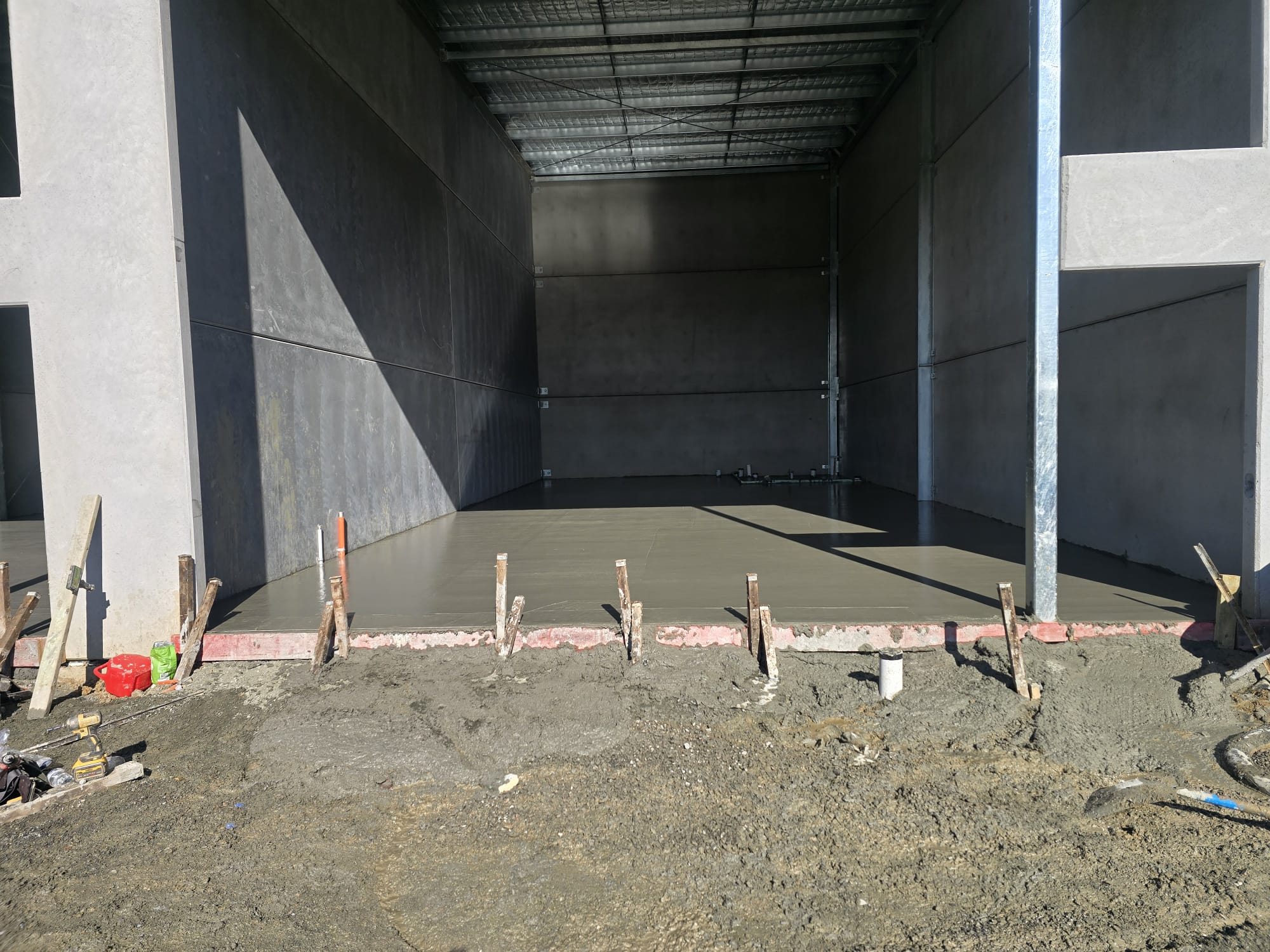
As a general guide, a standard residential driveway or house slab is usually poured at around 25 MPa (N25), and footings are often specified at 32 MPa (N32). But the right mix is set by your concrete supplier and your engineer for the specific job, not by a rule of thumb. We pump whatever mix you order; this guide is to help you know what to ask for.
Here’s how mix strength works and which mix tends to suit which pour.

What does MPa mean on a concrete mix?
MPa stands for megapascals. It’s the compressive strength the concrete is designed to reach, usually at 28 days. A higher MPa means a stronger, more durable mix. You’ll see it written as a grade like N20, N25 or N32, where the number is the strength: N25 is 25 MPa, N32 is 32 MPa, and so on.
Strength isn’t the only thing that matters, but it’s the headline figure your supplier and engineer use to spec a mix for the load and the conditions. A footing carrying a house needs more strength than a garden path. Getting the grade right is about matching the concrete to the job: strong enough to last, without overspending on strength you don’t need.
Which concrete mix do I need for a driveway?
For a standard residential driveway, around 25 MPa (N25) is the common choice, with a minimum recommended strength of about 25 MPa under Australian guidance and a slab thickness usually starting at 100mm. A driveway carries cars, so it needs more than a path but generally less than a structural footing.
That’s a guide, not a spec for your block. If your driveway will take heavier vehicles (a caravan, a truck, a boat trailer) or it’s on reactive clay, your engineer may call for a stronger mix or extra reinforcement. Always confirm the grade with your concrete supplier and engineer for your actual driveway before you order.
A driveway is a ground-level pour, so a line pump or a small pump usually places it without trouble.

Which mix do I need for a house slab?
For a residential slab-on-ground (the kind most homes sit on) around 25 MPa (N25) is a common starting point, but the slab is designed as a system under Australian Standard AS 2870 (residential slabs and footings), which takes in the soil classification, the slab design and the reinforcement together. The mix strength is one input; the engineer’s design ties it all together.
This is why you don’t pick a slab mix off a chart. On the reactive clay soils common around Maitland and parts of the Hunter, the soil class drives a lot of the design, and the engineer specifies the mix and reo to suit. Order what your engineer’s plans call for, and confirm the grade with your supplier. For a structural or suspended slab, the design falls under AS 3600 and the strength is usually higher again.
A large slab pour is where pump choice matters for keeping a steady flow. See boom pump hire for high-volume or hard-to-reach slabs.
Which mix do I need for footings?
Footings are commonly specified at 32 MPa (N32). AS 3600 is frequently cited for a minimum of around 32 MPa on exposed and structural footings, because footings carry the structure’s load down into the ground and sit in contact with soil and moisture. They’re working harder than a path or a basic slab, so they’re usually a stronger grade.
As always, this is a guide. Your engineer specifies the footing mix for your build, and on a structural job that figure comes off the plans, not a blog. If your footings are part of a slab system, they’ll be covered in the same AS 2870 design as the slab. Order to the plans and confirm with your supplier.
Does the mix affect whether it can be pumped?
Most standard mixes pump fine. What matters for pumping is that the mix is workable and consistent: the right slump, well mixed, and not too stiff. Your supplier sets the mix up to be pumpable when you tell them it’s going through a pump, so always mention that when you order. A mix batched for a chute and a mix batched for a pump aren’t always the same.
Some decorative and specialty mixes (exposed aggregate, coloured, polished or larger-aggregate mixes) can still be pumped, but it’s worth flagging them when you book so we can plan for it. If you’ve got a decorative or unusual mix coming, tell us the details and we’ll let you know how it pumps and which pump suits.

FAQ
What concrete mix do I need for a driveway in Australia?
For a standard residential driveway, around 25 MPa (N25) is the common choice, with about 25 MPa often given as the minimum recommended strength and a slab thickness usually starting at 100mm. A driveway carries vehicles, so it needs more strength than a path but generally less than a structural footing. That figure is a guide, not a spec for your block. If the driveway will take heavier vehicles like a caravan or boat trailer, or it’s on reactive clay soil, your engineer may call for a stronger mix or more reinforcement. Always confirm the grade with your concrete supplier and engineer for your actual job before ordering. When you book the pump, mention the mix so the supplier batches it to be pumpable, and we’ll match a line or small pump to your access.
What strength concrete is used for footings?
Footings are commonly specified at around 32 MPa (N32). Australian Standard AS 3600 is frequently cited for a minimum compressive strength near 32 MPa on exposed and structural footings, because footings carry the building’s load into the ground and sit in contact with soil and moisture, so they work harder than a slab or path and are usually a stronger grade. That said, the figure for your build comes off your engineer’s plans, not a general guide. If your footings are part of a slab system, they’ll be covered in the same residential slab design (AS 2870) as the slab itself. Order exactly what the plans specify and confirm the grade with your concrete supplier. We pump whatever mix you order, just let us know it’s going through a pump so it’s batched right.
What does MPa mean in concrete?
MPa stands for megapascals. It’s the compressive strength the concrete is designed to reach, usually measured at 28 days. A higher MPa means a stronger, more durable mix. You’ll often see it written as a grade like N20, N25 or N32, where the number is the strength in MPa: N25 is 25 MPa, N32 is 32 MPa, and so on. It’s the headline figure your concrete supplier and engineer use to match the mix to the load and the conditions. A footing carrying a house needs more strength than a garden path. Strength isn’t the only factor (slump, aggregate and reinforcement all matter too), but it’s the number you’ll be quoted when you order. Getting the grade right means concrete strong enough to last without paying for strength the job doesn’t need.
Can you pump any concrete mix?
Most standard mixes pump without trouble. The key is that the mix is workable and consistent, with the right slump, well mixed, and not too stiff, so always tell your concrete supplier the concrete is going through a pump when you order, because a mix batched for a chute isn’t always set up the same as one batched for a pump. Decorative and specialty mixes (exposed aggregate, coloured, polished, or mixes with larger aggregate) can usually still be pumped, but they’re worth flagging when you book so we can plan the right pump and approach. If you’ve got an unusual or decorative mix coming, give us the details and we’ll tell you how it pumps. Across Newcastle, Maitland and the Hunter, we pump residential and commercial mixes day in, day out.
Who decides what concrete mix I need?
Your concrete supplier and your engineer decide the mix, not the pump company. For a structural job, the engineer specifies the grade, slump and reinforcement on the plans, designed to the relevant Australian Standard (AS 2870 for residential slabs and footings, AS 3600 for structural concrete). The supplier then batches the concrete to that spec. The guide figures you’ll see around, roughly 25 MPa for driveways and house slabs and around 32 MPa for footings, are starting points, not a substitute for the plans. Soil type, load, exposure and design all shift the answer, which is why reactive clay around Maitland and the Hunter often drives a stronger or differently reinforced mix. Order to your plans, confirm with your supplier, and tell us it’s a pump job so it’s batched to flow.
Get your pour sorted
Once you’ve confirmed the mix with your supplier and engineer, we’ll handle getting it where it needs to go, whether driveway, slab or footings. Tell us the volume, the mix and the access, and we’ll match the right pump to the job.
We hire across Newcastle, Maitland and the wider Hunter on a booked, planned basis. Call 0419 252 930 for a quote.
What Others Are Reading:

Our Services
Get A Free Quote
Contact us today for a free, no-obligation quote on your concrete pumping needs.